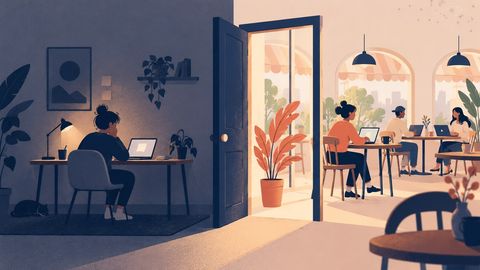
19.2% of freelancers feel lonely often or always, against 7.7% of the general population, though 54% say self-employment improved their mental health. The problem is not freelancing itself but how the week is built: people who spend at least half their time interacting with others report loneliness around a third of the time, against 49.7% for those working mostly alone. Evening meetups will not fix that, contact has to happen inside working hours. Put one person inside your working hours, book the exchange you already value, and name the unofficial work you are quietly carrying.
Nobody puts this one in their newsletter. Rates, pipelines, tax deadlines, yes. The fact that you have not had a proper conversation since Monday, no.
The Leapers 2025 report, published in January 2026 from a survey of 1,013 self-employed people, found that 19.2% feel lonely often or always. In the general population that figure is around 7.7%. Another 26.4% of freelancers feel lonely some of the time, which puts nearly half of the profession somewhere on the scale.
And then the same report says something that complicates the story: 54% say self-employment has improved their mental health overall. Among people who actively chose self-employment it is 72.7%. Among people who were pushed into it, 45.7%.
So freelancing is not the problem. The way most freelance weeks are built is.
What you actually lost when you went solo
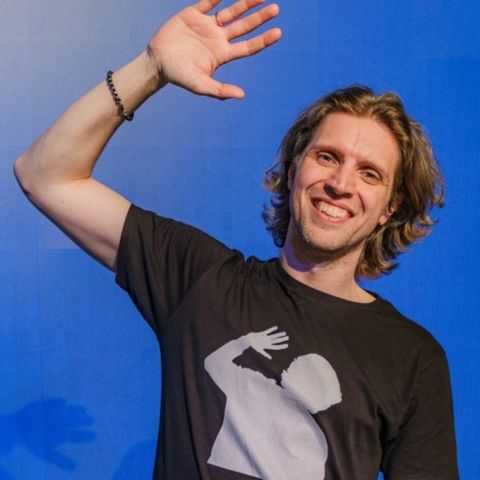
Judith Böhlert, a freelance software engineer, gave a talk at Freelance Unlocked 2026 about impostor syndrome, procrastination and distraction. Halfway through she named the mechanism behind all three, and it explains the loneliness numbers just as well.
Employment quietly provides scaffolding. Performance reviews and promotions supply external validation. Meetings, however much you hated them, supply structure. A commute supplies a boundary. And there are people around.
"There's no HR department, no manager telling you not to eat lunch at your desk, and no co-workers asking you to join them for a coffee." (Judith Böhlert)
Then all of that disappears in a single week, usually the week you were most excited about your new freedom.
"You didn't just lose your discipline. You lost the structures that were holding it up." (Judith Böhlert)
That sentence is worth borrowing for the isolation question. You did not become a less social person when you started freelancing. You lost the twenty small social contacts per week that came free with an office and never replaced them, because nobody tells you they were part of the job.
The research caught up in 2026
Loneliness among self-employed people was, until recently, a footnote in entrepreneurship research. In 2026 that changed. Maren Umdasch and Elisabeth Berger published the first integrative review of the field in the Journal of Small Business Management, pulling together 163 papers from entrepreneurship, leadership and workplace research into one framework.
Two things in it are useful on a Tuesday afternoon.
First, loneliness runs along three dimensions at once: individual, social and work. The work dimension is the one freelancers usually ignore. Long solitary hours, decisions carried alone, no colleague who understands the specific thing that just went wrong: that is not a personality trait, it is a job design.
Second, the review separates state loneliness from trait loneliness. Trait loneliness is stable and travels with a person. State loneliness is situational, tied to circumstances, and it moves when circumstances move. Most freelance loneliness is the second kind, which is the good news buried in an academic paper.
The wider health picture is not gentle. The WHO's Commission on Social Connection reported in June 2025 that one in six people worldwide is affected by loneliness, that it is linked to an estimated 871,000 deaths a year, and that lonely people are twice as likely to become depressed. This is a public health topic, not a character flaw, and it is worth treating with the same seriousness you give a persistent pain in your back. If it is heavy and it does not lift, talk to a doctor or a therapist rather than to a productivity blog.
The finding that changes what you do about it
Here is the part of the Leapers data that is genuinely actionable. Among self-employed people who spend at least half their working time interacting with others, the share reporting loneliness some of the time or more falls to around a third. Among those working mostly alone, it is 49.7%.
Note what is being measured. Not where you work. Not whether you moved to a coworking space or stayed at the kitchen table. Whether there are other people inside your working hours.
That distinction matters because most advice aims at the wrong slot in the calendar. Evening events, weekend meetups and a drink after the deadline all sit outside working time, which is exactly when a tired solo worker cancels. Contact during the work itself is the thing the data points at: a pair-programming session, a shared studio afternoon, a standing call with two other freelancers where everyone works with cameras on and talks in the breaks, a client team you actually sit with.
The DACH numbers show how far most of us are from that. In the Freelancer-Kompass 2026, with 5,412 respondents, 15% name isolation as a challenge. Asked what they get out of networking, 55% say new projects and acquisition, 49% say professional exchange, and 14% say social contacts. We network for leads, treat human connection as a side effect, and then wonder why the side effect is thin. Our piece on how freelancers actually win clients through networking makes the case that the lead-generation version works better when it is not the point either.
The other thing that isolates you: carrying jobs nobody gave you
There is a second kind of alone that the surveys do not capture, and it turns up in almost every freelance project.
Clemens Glade, a systemic communication consultant, ran a session at Freelance Unlocked 2026 where the whole room stood up. Three slips of paper on the floor, one step apart: me, the official assignment, the unofficial assignment. You stand on each one and notice what your body does.
His own examples: hired for content, quietly turned into the project manager. Hired for PR at an airline, quietly turned into the coach for a marketing lead going through a personal crisis. Hired for PR at an agency, quietly turned into the in-house advocate for inclusive language.
"The unofficial assignment is almost never spoken out loud, but it is emotionally expected." (Clemens Glade, translated from German)
Please calm our chaos. Please hold the team together. Please absorb the pressure. Take on enough of that and you end up doing emotional labour for an organisation that is not yours, with no colleagues in it, which is a specific and exhausting kind of lonely. In the Q&A someone raised the liability angle too: work you were never contracted for is work you can still be blamed for.
Glade's answer is not a boundary speech. It is a conversation.
"Professional closeness needs professional distance. Not coldness, not hardness. Clarity." (Clemens Glade, translated from German)
Practically: name the extra work out loud, ask where it ranks against what you were hired for, and ask whether it belongs in the existing contract or a new one. Sometimes the client says no and you have your answer cheaply. His closing line to the room was the one that stuck:
"Just talking about it, just telling someone, takes an enormous amount of pressure off. So don't keep it to yourself. Go to other people, share it." (Clemens Glade, translated from German)
Community helps, and it is not a magic word
Böhlert's version of the same advice comes with a caveat worth keeping. She recommends breaking the silence: at the freelance barcamp she co-organises, someone facilitated a session where people talked about their biggest failures, and she called it solid gold. Her line was that impostor syndrome feeds on silence, and community can be the antidote.
Then, asked in the Q&A how much of her own progress came from her network, she did not oversell it:
"It definitely helped to feel not alone in this, but I think most of it was a personal effort." (Judith Böhlert)
That is the honest shape of it. Community removes the false belief that you are the only one struggling, which is a large part of the weight. It does not do the rest of the work. Anyone selling you a Slack invite as a cure is selling you something.
One more thing from her talk, for people who measure themselves against a career ladder that no longer exists:
"Lately, my only measure of success has been whether or not I like how I spend my time on a random Tuesday." (Judith Böhlert)
Freelancing has no promotions, no performance reviews and no salary bands, so success becomes invisible while failure stays extremely visible. Our piece on the psychology of successful freelancing goes deeper into the mental traps that grow in that gap, and the one on working through a permacrisis covers what to do when the market itself is the stressor.
What to do on Monday
- Put one person inside your working hours. Not a coffee at seven in the evening. A working session at eleven in the morning: a shared call with two freelancers, a pairing hour, a client team you sit with in person. The Leapers data points at contact during work, not after it.
- Book the exchange you say you value. Half of freelancers say professional exchange is what networking is for, then never schedule it. One recurring 45-minute call with someone in your field, in the calendar, repeating.
- Do the three-slip exercise on your biggest project. Me, official assignment, unofficial assignment. Write down what you are carrying that nobody hired you for, then raise one item of it with the client this week.
- Say one true thing out loud. To a peer, in a group, or in a post if you like being seen. The point is breaking the silence, not the audience size.
- Check your Tuesday. If you do not like how you spend a random Tuesday, that is data about your setup, not evidence about you.
None of this needs a personality transplant. It needs other people scheduled where the work is.
That is also why we keep running Freelance Unlocked as a room full of people rather than a stream of talks, and why the 9am community sits next to the platform. If you want the work side of that too, create a free profile on 9am and get matched with projects that put you in a team instead of at a desk on your own.
Freelance Unlocked is co-organized by 9am together with Uplink and freelancermap. This article draws on the sessions of Judith Böhlert and Clemens Glade at Freelance Unlocked 2026. Watch the full talks above, and join us at the next edition: freelanceunlocked.com.