Forcing yourself to switch off does not move the needle for business owners: a study of 1,043 entrepreneurs found psychological detachment has no significant link to wellbeing, while relaxation and control do, strongly. Freelancers are especially short on control, working 42 hours a week on average with 12% over 50, and 76% take less time off than an employee's legal minimum. People who take no time off at all are four times less likely to report good mental health. Build five-minute role-switch routines, protect two fixed weekly blocks, and treat relaxation as work, not guilt.
The advice never changes. Phone away, laptop shut, mind clear. If you are still thinking about the client at eleven at night, you are doing self-employment wrong.
For people who run their own business, that advice does not hold up. And this is not a comforting excuse. It is a measurement.
In July 2025, Le Moal, Thurik, Torrès and Soenen published an analysis of daily recovery among business owners in Small Business Economics: 1,043 responses across four surveys, 993 of them used in the analyses. They tested the four standard recovery dimensions against wellbeing and burnout. One result breaks the pattern. Psychological detachment, the ability to mentally leave work behind, was not significantly associated with wellbeing in this group. Relaxation and control were, strongly.
So if you have spent years quietly ashamed that you cannot switch off, you have been ashamed of the one dimension that predicts nothing here.
What the study actually measured
Recovery research splits rest into four things, and the difference between them is the whole story.
Detachment means the work is no longer in your head. Relaxation means your body and nervous system settle, regardless of what you are thinking about. Mastery means spending off-hours getting better at something: a language, a sport, an instrument. Control means you decide what happens when.
Among the owners surveyed, control had the strongest association with lower burnout. Relaxation and control had the strongest associations with higher wellbeing. Detachment did not clear the bar for wellbeing, and mastery did not clear it for burnout.
There is a second finding that stings more. Owners scored lower than employees on all four dimensions, and lowest of all on detachment. The authors put that down to the link between the person and the business. When the company is yours, it does not go home without you.
Two caveats before you apply this to your own Tuesday. The sample is French, and it is business owners rather than freelancers specifically. And the TK-Stressreport 2025, which gives the German baseline, has no separate breakout for self-employed people, so treat it as context and nothing more. What it does say is worth keeping: 66% of people in Germany feel stressed frequently or sometimes, and the most named stressor is not clients or deadlines. It is their own high expectations, at 61%. For a profession that sets its own standards, that number should land.
Why detachment fails for solo work
There is an explanation for this that lives in the brain rather than in willpower, and it came from a stage at Freelance Unlocked 2026.
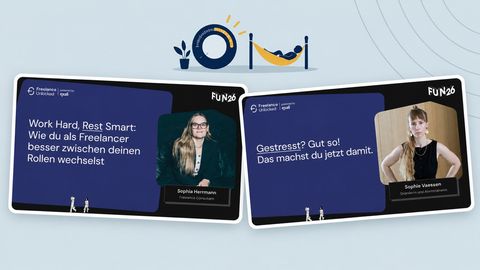
Sophia Herrmann is a freelance consultant with a psychology degree. Her core claim sounds mild and quietly reframes the whole problem.
"Being productive and being rested is not only a question of time management. It is a question of role management." (Sophia Herrmann, translated from German)
Her image for it is unexpectedly current:
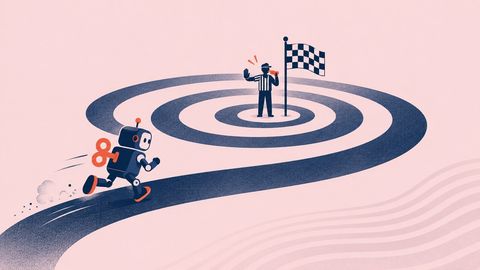
"I want you to picture roles the way you picture an AI agent, one your brain builds automatically." (Sophia Herrmann, translated from German)
Your head builds one of these agents for each context so it does not have to sift through everything it knows every time you sit down. That saves energy. Switching between two of them costs energy, because you have to recall a different set of goals and regulate the leftover feelings from the last one.
How expensive the switch is depends on how far apart the two roles sit. Her own example: hopping between five client projects is effortless, because she behaves almost identically in all five. Getting into bookkeeping is a proper relocation. Both have a downside. Close roles switch easily and hold focus badly. Distant roles hold focus well and switch badly.
Which is exactly why the traditional end of the working day collapses. For most of us, freelancer and private person are very close roles: same room, same device, same voice, same person. Close roles are comfortable and terrible at focus. You did not run out of discipline. You have two agents that look too much alike.
Her answer is not harder boundaries. It is transitions.
"Routines are basically mini role-switch scenarios for your brain." (Sophia Herrmann, translated from German)
The routine she brought takes five minutes and is completely unglamorous. At the end of the working day you write down the three most important things you are leaving unfinished, and explicitly give yourself permission to leave them. Then you write down three things you want to pick up in your private life. That is the switch. No fixed five o'clock finish required, because you run it whenever the moment arrives.
The same mechanic works between client projects: three takeaways written down after each call, three intentions written down three minutes before the next one. And if you actually want a new habit to stick, use what psychologists call an implementation intention, a plain if-then sentence. If I close the laptop, then I run the routine. Resolutions without a trigger evaporate. Resolutions with one survive.
Control is the lever, and DACH freelancers are short of it
If control is the dimension carrying most of the weight, it is worth asking how much of it is left in an average freelance week.
The Freelancer-Kompass 2026, with 5,412 respondents, records a working week of 42 hours on average, two more than the year before. Some 12% work more than 50 hours. Non-billable work eats 12% of the total. On the better side, holiday allowance rose to 29 days from 27.
Whether that holiday gets taken is another matter. In the Leapers 2025 report, a survey of 1,013 self-employed people, 76% took less time off than the legal minimum an employee would get. Just over 10% took no days off at all. And then comes the number that ends the argument: people who took no time off were more than four times less likely to report good mental health than those who took more than the employment equivalent. That is 6.3% against 27.4%.
Control, in the sense the study means it, is not about working less. It is about deciding. And the usual places freelancers lose it are ordinary and fixable. Clients who own your calendar. A messaging channel where you are permanently reachable. Meetings dropped into your deep-work blocks by other people. A bank balance that makes every "no" expensive. That last one is the honest one. What utilization actually depends on in 2026 is the subject of our piece on the €103 paradox, and without reserves, control stays a word.
Two things follow for this week. First, put your recovery where nobody else gets a vote, instead of hanging it off the end of a list that is never finished. Second, relaxation is the other load-bearing dimension, and it is remarkably plain. The TK report's most helpful strategies are walking and time in nature at 83%, hobbies at 78%, and seeing family or friends at 78%. None of them require you to stop thinking about work while you do them.
Stress is not the enemy, but it stays in the body
The second voice from Berlin supplies the part the study can only measure as a score.
Sophie Vaessen, a founder and breathwork coach, opened her session by separating two words most people use interchangeably.
"That is not the stress. That is the stressor. Stress is what happens in your body." (Sophie Vaessen, translated from German)
The deadline, the late train, the unanswered email: those are stressors. Stress is the response, meaning hormones, heart rate, breathing. Which gives you the sentence that explains why the evening does not improve even after the problem is solved:
"When the train finally arrives, the stress is very possibly still there. It is still in your body, because we never did anything with it." (Sophie Vaessen, translated from German)
She then asked the room how the traffic between head and body is split. In her model, roughly 20% runs from the head down and 80% runs from the body up. Which means talking yourself out of a bad day is working through the narrower channel. Posture, movement, breathing and a phone call to someone who genuinely calms you down all get there faster than a pep talk. That is relaxation in the recovery-science sense, and it is exactly why it works while detachment does not.
Her second image is the window of tolerance. Everyone has a personal range of activation they can handle, and that range moves with the season of your life. When a lot is going on, the window narrows, and things that would normally bounce off suddenly do not.
"The best moments to train that window of tolerance are the moments of stress." (Sophie Vaessen, translated from German)
Her goal is explicitly not permanent balance.
"It is about flexibility. You want to be able to handle the highs and lows that life hands you." (Sophie Vaessen, translated from German)
She added her own warning, and it matters. Highly activating methods such as intense breathwork or ice baths are not tools for an already overloaded nervous system. In those phases, the gentle things are the ones that work: sleep, food, movement, rest, other people. And if the weight stays instead of lifting, it belongs with a doctor or a therapist rather than with an article about work.
What a week built for recovery looks like
If control and relaxation are the load-bearing dimensions, the week that follows from that looks different from the standard digital-detox checklist.
Set fixed points that belong to you. Two or three appointments a week that are as non-negotiable as a client call. Not "exercise if there is time", but Tuesday at six. Control comes from decisions made in advance.
Build transitions instead of walls. Five minutes at the end of the day, three minutes between projects. That is the role switch your brain is asking for, and it is far cheaper than another vow to stop at five sharp.
Separate the distant roles physically too. Do bookkeeping at the kitchen table rather than the project desk, in a different browser, at a different time. Sophia's point is that the brain needs an external signal that a different role is running.
Plan recovery by body, not by calendar logic. The evening after a hard negotiation is not the evening for a demanding hobby. It is the evening for a walk. That is not laziness, it is the dimension that best predicts how you feel.
Take the holiday you already wrote down. The Kompass says 29 days. Put two blocks of it in the calendar now, before the projects do it for you.
What to do on Monday
- Set up a five-minute close. Three things you are leaving, with explicit permission to leave them. Three things you are looking forward to outside work. Done.
- Write one if-then sentence. "If I close the laptop, then I run the routine." A trigger beats a good intention every time.
- Block two slots nobody may move. One for recovery, one for the work that is yours. Control is the dimension doing the heavy lifting.
- Relocate one role. Bookkeeping, proposals or acquisition off the project desk. A different table is enough.
- Give the body two minutes after a stressful call. Stand up, shake it out, breathe, step outside. The stressor is gone. The stress is not.
None of this is a plan to work less hard. It is the order the data suggests: control and relaxation first, then the question of whether your mind lets go. Why being alone is its own separate factor is covered in our piece on freelancer loneliness, and the mental patterns behind the permanent sprint are in the psychology of successful freelancing.
And since a full calendar is easier to steer than an empty one: create a free profile on 9am and let projects come to you, instead of filling every gap with acquisition.
Freelance Unlocked is co-organized by 9am together with Uplink and freelancermap. This article draws on the sessions of Sophia Herrmann and Sophie Vaessen at Freelance Unlocked 2026. Watch the full talks above, and join us at the next edition: freelanceunlocked.com.