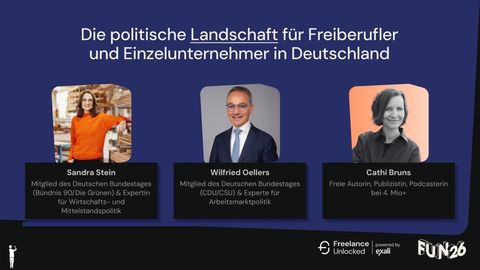
Ask German politicians to grade their own country as a place to run a business, and the answers land between a C and an F. That's how the politics panel at Freelance Unlocked 2026 opened: with a sober self-assessment straight from the Bundestag.
On stage: Wilfried Oellers, member of the Bundestag for the CDU/CSU since 2013, a lawyer and labor market policy expert; Sandra Stein, a family business owner and her Green parliamentary group's rapporteur for SMEs, skilled trades and the self-employed; and Cathi Bruns, author, commentator and founder of the 4 Mio+ initiative, one of the loudest voices for Germany's self-employed.
The diagnosis: 90 percent feel disrespected
The tone was set by a number from Sarah Weber's keynote that same morning: 90 percent of self-employed people don't feel respected by politics. None of the three pushed back.
Stein confirmed it from her own first year in parliament. In measures like the Aktivrente, the retirement savings depot, or the briefly planned 1,000-euro tax-free bonus, the self-employed were "fundamentally forgotten." She has since set up a self-employment roundtable with fellow MPs and explicitly doesn't exempt her own party: the topic is "a bit of a blind spot."
Oellers drew a finer line: within his parliamentary group, self-employment ranks high, but what actually gets legislated doesn't match that ranking. More striking was his point about access. He keeps hearing from associations that some parliamentary groups simply decline meeting requests from business representatives, in his experience mainly the SPD and the Left party. "Turning down requests for a conversation, that's an absolute no-go."
Bruns went a level deeper. That self-employment is treated as a special status at all is, for her, the root problem:
"Making policy against the self-employed means making policy against your own economy." (Cathi Bruns)
The numbers back her up. Germany has been losing self-employed people for years; the share of solo self-employed in the workforce keeps shrinking and stood at 3.5 percent in 2025. The mood matches: the Jimdo-ifo business climate index reported the worst business situation for the self-employed since the index began in early 2026, and respondents graded economic policy at 4.3 on Germany's school scale of 1 to 6.
The nanny state and an outdated image of entrepreneurs
Why does so little change when the problem is well known? The panel offered three explanations.
First, mentality. Oellers has watched a growing full-coverage expectation since his first term, one that got "a real push" during the pandemic. Politics believes it must prescribe everything for society, "and that simply doesn't work." Bruns turned the argument around: the state cares intensely where care isn't needed, while no longer trusting people to run their own lives. The self-employed don't want wraparound protection. They want to work.
Second, representation. Stein pointed to an uncomfortable statistic: fewer and fewer MPs bring entrepreneurial experience. The FDP used to lift those numbers; today the far-right AfD counts the most business owners of any group in the Bundestag. "Maybe that says something about the AfD, but it certainly says a lot about the other parliamentary groups."
Oellers added a point that often gets lost: abuse in individual sectors, he named the meat industry and its subcontracting schemes, is no argument against the self-employed as a whole. There, lawmakers tightened the rules surgically and strengthened customs inspections. That precision instead of blanket suspicion is what he demands for the coming reform too.
Third, exposure. Self-employment used to be everyday life in Germany, from the family farm to the carpentry shop to the corner store. The fewer people run their own business, the fewer children grow up around one, and school curricula barely touch entrepreneurship. Bruns's verdict: "Germany has a broken relationship with self-employment." Her remedy isn't an image campaign but normalization, in schools, in families, in language. Even the term "Normalarbeitsverhältnis," normal employment, for a permanent position quietly declares every other path an anomaly.
Priority one: fix false self-employment
For all their differences, the three agreed on one thing: reforming the status determination procedure, known to every freelancer as the false self-employment problem, is the most urgent file. Oellers, who has worked on it since 2013 and negotiates for the conservatives, was blunt: today's criteria of instruction-boundness and integration are "simply too thin," and case law isn't helping. Lawmakers need to define clear criteria themselves. His dry take on the first leaked draft: it "didn't exactly turn out great."
Bruns turned the priority into arithmetic. Germany is in a competitiveness crisis, debates expensive stimulus packages, and leaves the cheapest instrument on the table:
"Liberalizing independent work is a stimulus program that costs nothing at all. Just let us work." (Cathi Bruns)
Add the clock ticking underneath: entrepreneurial families now advise their own children against self-employment, and the Mittelstand is heading into a massive succession gap. Every year without reform makes both worse.
Asked point-blank whether the reform lands this year, Oellers committed: parliamentary timelines make it possible, and yes, he gives his word to fight hard for it. That matches the coalition agreement's promise of a faster, more transparent and legally secure status procedure. For what the negotiations mean in detail, read our companion piece on the expert panel: Germany's false self-employment reform: experts dissect the leaked draft.
Right behind it, for all three: bureaucracy. Stein told of Etsy sellers despairing over packaging regulations written with corporations in mind and dumped on solo businesses. As a hopeful sign, Oellers pointed to decisions in North Rhine-Westphalia and Baden-Württemberg to abolish documentation and reporting duties by default, keeping only those that can be justified. A reversal of the burden of proof that could serve as a blueprint at federal level.
What freelancers should watch now
Two hours of panel boil down to a concrete watchlist for the coming months:
- Does the status reform land in 2026? Oellers has given his word; the coalition agreement provides the basis. Whether the final bill contains positive criteria that reflect real business models is the litmus test. Until then the old rules apply, and a few minutes with 9am's free false self-employment self-check tell you where your own setup stands today.
- Who gets included in relief packages? Aktivrente, savings depot, tax bonuses: whether the self-employed are considered from the start will show if perception has actually shifted.
- Bureaucracy reduction with reversed burden of proof: whether the state-level model makes the jump to federal law.
- The Greens as a social-liberal home? Stein wants to occupy the space the FDP left behind. Roundtables and an economic advisory board are the early evidence to track.
And Bruns's appeal goes to the self-employed themselves: be visible, speak up, defend your way of working. "Losing freedom happens fast, and winning freedom back is harder."
The best moment to put your own business on stable footing doesn't depend on Berlin: it's now. Create a free profile on 9am and get in front of clients who deliberately work with freelancers.
Freelance Unlocked is co-organized by 9am together with Uplink and freelancermap. This article is based on the panel discussion with Sandra Stein, Wilfried Oellers and Cathi Bruns at Freelance Unlocked 2026. Watch the full talk above, and join us at the next edition: freelanceunlocked.com.