
42% of US independents call online platforms their main way to find work, but the DACH data cuts the other way: platform project postings nearly halved from about 97,400 in 2022 to 56,000 in 2025, and 62% of freelancers now name client acquisition as their biggest obstacle. More than 80% of contractor bookings still happen through direct networks, not open applications, and clearly positioned profiles get shortlisted roughly 2.5 times more often than generalist ones. The fix is not choosing one channel. Split your time across platforms, your own client network, and events where your buyers actually are.
In the United States, 42% of independent workers now name online platforms as their primary method of finding work. That comes from MBO Partners' 2025 State of Independence, published in September 2025 and covering a workforce of 72 million people. Platforms have overtaken networking as the front door to independent work.
Before you read another line: 9am is a platform. We match freelancers with companies in DACH, and we make money when that works. So treat everything below the way you would treat a bakery's report on the health benefits of bread, and notice that we are about to spend most of the article on the evidence that cuts the other way. In this market it does.
What the platform data actually shows
The MBO numbers are not marginal. Among independent professionals who provide services to businesses, platform use rose from 37% in 2020 to 63% in 2025. The average person uses 3.1 platforms, up from 2.6. And the share calling platforms a primary or important source of work climbed from 57% to 78%.
The most interesting line in that dataset is the quietest one. Private and enterprise talent platforms, meaning closed pools rather than open bidding sites, went from 9% to 24% in five years. The growth is not at the race-to-the-bottom end of the market. It is in curated pools where a few vetted people are shown to a few buyers.
The buyer side explains why. YunoJuno's 2026 rates report, built on more than 182,000 workforce data points, notes that a contractor can be onboarded within hours where a permanent hire takes three to six months. Speed is what companies are buying.
And now the number that spoils the story
The same YunoJuno report says that more than 80% of contractor bookings happen through direct networks. Not through open searches. Through people the client already knew, or someone in the client's circle vouched for, with the platform acting as the contracting rail rather than the discovery mechanism.
In DACH the picture is harsher still. According to the freelance.de Freelancer-Studie 2026, project postings on the platform fell from around 97,400 in 2022 to around 56,000 in 2025. That is close to a halving of visible supply. Over the same period more people entered the freelance market. In the Freelancer-Kompass 2026, with 5,412 respondents, 62% name client acquisition as their single biggest obstacle. And 26% now need longer than three months to land a project, up from 20% the year before, while only 3% find one inside a week.
So the honest version of the headline is this. Platforms are the most-used channel and they are not the highest-converting one. Fewer projects, more applicants, and the good briefs are decided before anyone posts them.
What actually happens to your application
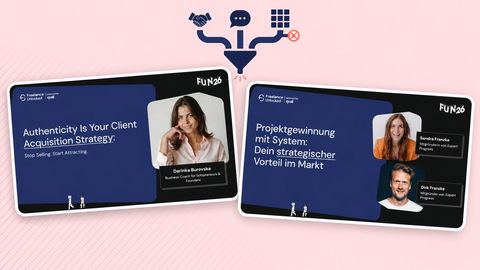
Dirk Franzke spent over ten years inside the German project-brokerage market and has placed, by his own count, more than 25 million euros of project volume across some 250 placements. He ran his Freelance Unlocked 2026 session with Sandra Franzke, who has fifteen years in marketing and brand and now works with freelancers and interim managers on positioning. Together they described the funnel from the inside, and it is not the funnel most freelancers imagine.
A request arrives at a provider by phone, email or WhatsApp. Before it goes anywhere near a portal, the person who took the call runs through the ten or fifteen people they already trust for that kind of brief. Dirk described one large German interim provider that keeps a WhatsApp group for exactly this, and a client of theirs whose inner circle of 52 experts sees projects before any portal does.
Only when that fails does the project get published. Then, by Dirk's figure, roughly 130 applications land on one posting, and three to five profiles go to the client.
"At 200 profiles you are just comparable. In the inner circle you are one of very few." (Dirk Franzke, translated from German)
Sandra's half of the talk is about surviving the first filter, and her key point is that the person reading your profile usually is not an expert in your field. They are looking for a category to put you in, fast. She quoted a recruiter who scans profiles constantly and often cannot tell where someone's focus lies, and put the window at six to thirty seconds.
"Many experts get overlooked, not because they lack competence or experience, but because they cannot get it across in a way that makes them selectable." (Sandra Franzke, translated from German)
Their claim, from their own client work, is that clearly positioned profiles make the shortlist about 2.5 times more often than profiles that present a broad tray of everything the person has ever done. Treat that as their number rather than survey data. The mechanism behind it is not in doubt: a reader with thirty seconds and 130 documents does not decode nuance.
Their model is four gears that have to turn together: market-ready positioning, deliberate anchoring with the right providers, your own direct clients, and keeping all three running while you are busy. Germany has more than 500 providers, Dirk said, of which maybe 20 are relevant to any one person and three or four end up being the ones that call. The fourth gear is where most people fail, because prospecting stops the moment a project starts. Two weeks before the contract ends, out goes the mass email announcing availability.
That is the mechanic behind the DACH numbers. Utilization is not lost in the negotiation. It is lost four months earlier. We covered the money side of the same problem in the €103 paradox, and the mechanics of never letting the pipeline empty in keeping a constant customer pipeline.
Positioning is not a pricing problem in disguise
Elina Jutelyte runs the Freelance Business Community. Her session started with a story against herself: she sent a client a value-based proposal, he asked how many hours were in it, and she lost him. A coach later gave her the uncomfortable version.
"You are trying to position yourself as a consultant, but what you described is not really being a consultant." (Elina Jutelyte)
Her conclusion has a direct bearing on channel choice.
"For me the pricing issue is not a pricing problem. It is a positioning problem." (Elina Jutelyte)
Her community's own research, she said on stage, found 76% of freelancers doubting their prices. Price doubt, in her reading, is what it feels like from the inside when the other elements are missing: no proof of your work, no evidence of quality, and the wrong rooms.
That last one decides the channel question. Her example was a speaker she met seven years ago with 3,000 Instagram followers and roughly ten million now. What he did right was not content strategy. He went to a conference for event planners, which is to say he stood in a room made entirely of his buyers.
Her cheapest fix is a project audit. List every project: what you delivered, the client's industry, what you were paid, how they found you. Find the pattern in the ones you want more of, then approach 25 people who match it. Not to sell, she stressed. To validate.
Two channels the surveys underrate
Kompass respondents were asked what networking gives them. 55% said new projects and acquisition, 49% professional exchange, 14% social contacts. We network for leads and treat the human part as a by-product, which is roughly the opposite of how the leads actually arrive. Our piece on why the network beats the feed goes further into that.
Kevin Arenja has been an event manager since 2013 and has run more than 120 events. His argument for the offline channel is one sentence long.
"People buy from people." (Kevin Arenja, translated from German)
His practical version is unglamorous. Call a client on Monday morning, ask which trade fairs and conferences they are attending in autumn, then go to those. Speak there if you can, exhibit if you cannot, and if neither, at least take home a contact who solves the problem your clients have immediately before or after the one you solve, because that relationship pays in referrals both ways. His own case study: a freelancer who exhibited at a large marketing conference and, by Kevin's account, pulled close to €100,000 in revenue from three mandates that would never have taken his calls otherwise. That is his figure from his own client work rather than an audited number, and the pattern is the part worth copying.
The other underrated channel is the one you cannot schedule. Darinka Burovska, a business coach for solopreneurs and founders, told the room about a founder who came to her wanting to scale ten times in a year when his product was nowhere near ready. She told him so, and told him what he actually needed, which was not what he had asked to buy.
"No one has ever said something like this to me before. Everyone just sells me the thing I asked for." (Darinka Burovska)
He hired a different coach. Then he introduced her to three founders in his community who became clients, introduced her to his investors, and invited her to speak at their events.
"Always give your best, always engage fully, and then let go of the outcome." (Darinka Burovska)
That is not a business model on its own. It is what the 80% of direct bookings in the YunoJuno data are made of, one conversation at a time, and it is why our piece on authenticity as a client acquisition strategy sits next to this one rather than against it.
A three-channel week that fits in two hours
The answer is not a channel. It is a mix, kept alive at low cost while you are billing.
Channel one, platforms and providers. Not thirty of them. Three or four that actually serve your industry and function, with a profile whose first screen says what problem you solve and for whom, plus a named contact at each you speak with like a human being. Budget: 30 minutes a week.
Channel two, your own clients and their circle. A simple CRM with everyone you have worked with, plus a standing habit of one status update or genuine check-in per week to someone who already knows your work. Look for the upsell inside the current project before you look outside it. Budget: 30 minutes.
Channel three, rooms with buyers in them. One event, meetup or community per quarter where your clients are, not one where your peers are. Follow up the same evening, before the day blurs. Budget: 30 minutes a week averaged out, plus the odd travel day.
The last 30 minutes is the audit Elina described, once a quarter rather than weekly: which of your last ten projects came from where, at what rate, and which of those you would want more of. Most freelancers have never counted this, and the count usually contradicts the effort split.
What to do on Monday
- Count where your last ten projects came from. Platform, provider, referral, past client, event, inbound. The channel that produced your best-paid work is rarely the one absorbing most of your time.
- Rewrite the first screen of your profile. One role, one sentence saying which problem you solve for whom with what result, then three achievements with outcomes. Six seconds is the budget you are writing for.
- Pick three providers and one human at each. Not thirty registrations. Three relationships, with a short message every few weeks about what you are working on and when you are free.
- Book one room your clients are in. Ask a current client which events they attend this autumn, then go to that one instead of the one for people who do your job.
- Do the fourth gear this week, while you are busy. One update to a past client, one message to a provider, one contact added. Fifteen minutes, on a recurring calendar entry, permanently.
Platforms are a real and growing channel, which is why the useful question is not whether to use them but what share of your pipeline they should carry. Ours works best as the layer that fills the calendar between the projects your network brings you. If that is the job you want done, create a free profile on 9am and let companies in DACH match against what you actually do.
Freelance Unlocked is co-organized by 9am together with Uplink and freelancermap. This article draws on the sessions of Dirk Franzke and Sandra Franzke, Darinka Burovska, Kevin Arenja and Elina Jutelyte at Freelance Unlocked 2026. Watch the full talks above, and join us at the next edition: freelanceunlocked.com.