
In July 2026, 21.2% of Germany's solo self-employed and micro-businesses said their economic existence is threatened, the highest share since the Jimdo-ifo index began, while the mood in the wider economy improved in the same month. Three separate 2026 surveys find that between 71% and 90% of the self-employed feel ignored or badly served by politics. None of that is in your hands. Four things are: your pipeline, your cash reserve, your rate, and the people you talk to when it gets hard. The second half of this article is about those four.
One in five. That is the number to remember from the summer of 2026. In July, 21.2% of solo self-employed and micro-enterprises told the ifo Institute that their economic existence is threatened. The April value was 20.6%. Since the Jimdo-ifo index started asking, it has never been higher.
The uncomfortable part is the contrast. In the same July, the ifo Business Climate Index for the German economy as a whole rose to 86.6 points, from 85.7 in June, and climbed again to 88.8 in August. Companies with staff and reserves are starting to feel better. The smallest businesses in the country are not.
This article lays out the numbers plainly, then turns to what one freelancer actually controls. Survey results describe the weather. They are not a forecast for you.
The July 2026 numbers, plainly
The Jimdo-ifo index covers solo self-employed people and firms with fewer than nine employees across all sectors, with a focus on services. In July 2026 the picture looked like this, according to the ifo release of 7 August and the VGSD's write-up of the same wave:
- Business climate: minus 22.6 points, up from minus 25.9 in June. Less bad, still deeply negative.
- Current situation: minus 19.5, after minus 22.5.
- Expectations: minus 25.6, after minus 29.2.
- Lack of orders: 47.3% report insufficient orders.
- Financing difficulties: 9.9%, the highest value since the third quarter of 2021.
- Existence threatened: 21.2%, the record.
Mood slightly better, fear worse, at the same time. ifo's Katrin Demmelhuber explains the mechanism: "Many self-employed feel that their customers are holding back on awarding projects. At the same time, private consumer demand remains subdued." And on why this group is hit harder than others: "The solo self-employed and microenterprises often lack the financial reserves to weather prolonged lean periods."
Jimdo CEO Matthias Henze put it in one line: "More than one in five self-employed sees their existence threatened, that's fatal." (translated)
Read that alongside the spring income data: DACH hourly rates held at around €103 while income fell, because billable days fell, as we showed in the €103 paradox. The July fear number is the emotional side of the same calendar problem.
Three surveys, three questions, one direction
The second story of 2026 is political. Three studies from three organisations, fielded between November 2025 and March 2026, asked the self-employed about politics. Different questions, so the figures are not interchangeable, but they point the same way.
"Do you feel respected by politics?" The Selbstständigen-Report 2026 by WISO MeinBüro and the VGSD (2,684 respondents, fieldwork mid-December 2025 to mid-February 2026) finds that around 90% feel little or no respect from politics as self-employed people. In 2018 it was 80%, in 2024 87%. The same survey: 38% have considered emigrating in the past two years, 6% have concrete plans. The top reasons are bureaucracy (41.6%) and taxes (around 40%). Only 46% rate their own business situation as good or excellent, down from 55% in 2024 and 60% in 2018.
"Do you feel sufficiently supported?" The freelance.de Freelancer-Studie 2026 (more than 3,300 participants, fieldwork 27 January to 2 March 2026) finds 71% feel insufficiently supported by politics, up from 66% a year earlier.
"Does politics set the right framework conditions?" The Freelancer-Kompass 2026 by freelancermap (around 5,400 respondents, fieldwork 17 November 2025 to 8 February 2026) finds 76% see the political framework for freelancers critically. 6% call it adequate.
Ninety, seventy-one, seventy-six. Different wording, same conclusion: a large majority of Germany's self-employed feel governed by people who do not have them in mind. What is actually moving in Berlin, from the status reform to the pension debate, is in the political landscape for freelancers. This article stops here on politics, because you cannot fix it on a Monday morning.
One figure from the Selbstständigen-Report deserves to stand next to the fear number, though: 83.3% would choose self-employment again. People are scared and frustrated, and they would still do it. That is the group this second half is written for.
What one freelancer controls
Half of the self-employed report too few orders, and you cannot change the market. Four levers move your own exposure to it, and the survey data points to them.
1. The pipeline, before the price
47.3% report a lack of orders. That is the number behind the fear number. The freelance.de data shows that even in this market, 25% of freelancers raised their rates last year, so pricing power exists for some. But a rate increase on an empty calendar is arithmetic on zero. The first lever is a pipeline that produces conversations every week, whether or not you need them this month. How to build one without turning into a salesperson is in the constant customer pipeline.
2. The reserve, so a bad quarter is a quarter
Demmelhuber's sentence about missing reserves is the most useful line in the whole release. Financing difficulties are at 9.9%, the highest since 2021, and the businesses reporting them are the ones that had no cushion when the dry spell started. A reserve does not change your order book. It changes what a lack of orders means: a quarter to work the pipeline instead of a threat to your existence. Six months of fixed costs is the figure experienced freelancers keep coming back to. If you are at zero, one month is the first goal, not six.
3. The rate, kept where it belongs
The temptation in a fearful market is to cut. 16% of freelancers did last year. Before you do, remember what the income data says: the problem is days, not price. A lower rate on the same number of days is simply less income. If a client pushes, shrink the scope, not the number. The playbook is in freelance pricing strategy and negotiation.
4. The people, because fear grows in silence
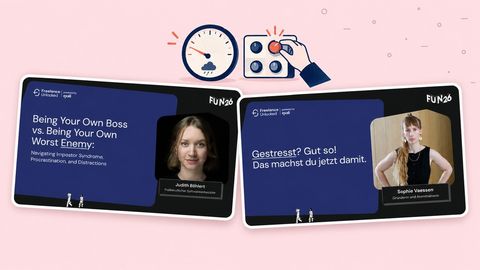
The surveys cannot measure this lever, and most freelancers skip it. Two speakers at Freelance Unlocked 2026 made the case better than any statistic.
Judith Böhlert, a freelance software engineer, spent her session on what happens in your head when you go solo. Her argument: the structures of employment quietly held you up, and when they disappear, something worse fills the gap.
"You didn't just lose your discipline, you lost the structures that were holding it up." (Judith Böhlert)
She is blunt about how visible failure becomes when you work alone: "Your success can feel largely invisible whereas failure is very visible because you alone are responsible for every little thing that goes wrong." Her fix is not a productivity hack. It is talking. "Imposter syndrome feeds on silence and community can be the antidote here." She describes a bar camp session where people simply shared their biggest failures, and calls it "solid gold." And she refuses to let the structural explanation become an excuse: "That doesn't mean that you don't have any agency either. Try to take small sustainable steps."
Sophie Vaessen, a nervous-system and breathwork coach, gave the German-language audience a distinction that applies directly to this data. The late order, the client who ghosts you, the tax letter: those are stressors. Stress is what happens in your body afterwards, and it does not leave just because the stressor did.
"That is not the stress, that is the stressor. That is what triggers the stress. Stress is what happens in the body." (Sophie Vaessen, translated)
Her practical point for a bad year: the moments of stress are the training ground. "The best moments to train this window of tolerance are the moments of stress." She lists what works when the day tips over: get up, shake it off, go outside, call a friend, move. And she names the thing freelancers underuse: co-regulation, "with other people who you know bring you down again", not the ones who add their own worry to yours. Her motto is "stress smarter, not harder", and the goal is not calm. "It's about flexibility. You want to be able to deal with the highs and lows that life gives you."
Together that is the fourth lever: a few people you can tell the truth about your numbers and your fear, before either grows in the dark. If you do not have them yet, the research on freelancer isolation and what helps is in our piece on loneliness.
What to do on Monday
- Write down your fixed costs for one month and how many months you have in the bank. That number, not the ifo index, is your personal fear gauge. If it is below one, that is the first project.
- Book two conversations this week with people who could hire you or refer you, regardless of your current workload. Pipeline is a habit, not a rescue.
- Look at your last three offers. If you cut the price on any of them, write down what scope you could have removed instead.
- Send one message to a freelancer you trust: "How is your order book really?" Answer honestly when they ask back.
- Next time a stressor lands, notice where you breathe. Then take five minutes away from the screen before you reply.
The market will do what it does. A free 9am profile puts your work in front of companies across DACH that hire freelancers, which is one more way to keep the conversations coming while the index sorts itself out.
Freelance Unlocked is co-organized by 9am together with Uplink and freelancermap. This article draws on the sessions of Judith Böhlert and Sophie Vaessen at Freelance Unlocked 2026. Watch the full talks above, and join us at the next edition: freelanceunlocked.com.