Most freelancers think clients do not need to know about AI use, but 25.9% of clients expect to be told without asking, and only 8.6% of freelancers do. A 4,093-person study found disclosing AI use lowers trust, but getting caught by someone else lowers it more, 2.49 versus 3.15 on a trust scale. Since 2 August 2026, Article 50 of the EU AI Act requires labelling AI-generated public-interest text and deepfakes, though human review exempts you. Put a short AI clause in every contract, review the work for real, and disclose the role AI played, not every tool.
Ask a room of freelancers whether clients need to know that AI helped with the work, and most will say no. In the largest study on the question so far, 53.8% of freelance workers said disclosure was unnecessary. Among their clients, only 40.7% agreed.
That gap is the whole problem. A quarter of clients (25.9%) expect to be told without asking. Only 8.6% of freelancers actually do it.
What the freelancer study found
The numbers come from Hwang, Wong, Chen, He and Do, presented at CHI 2026. It is the first study to put freelancers and their clients side by side: 41 interviews, a survey of 100 workers, and a matching survey of 145 clients.
78.83% of the freelancers used AI in their work. What they did about telling anyone splits into clear camps. 39% disclose only when a client asks. 22% disclose but wrap it in framing. 20% decide case by case. 12% are fully transparent by default. 7% actively avoid the topic. The paper's title comes from what the interviews sounded like: better ask for forgiveness than permission.
Two findings should change how you think about the risk. Clients rated their own ability to spot AI use at 3.11 out of 5, barely above the midpoint of the scale. And 81.25% of clients said they encourage AI use in some form. The people you are hiding it from mostly do not mind, and mostly cannot tell. That combination is exactly what makes silence feel safe and makes it expensive when it breaks.
The disclosure penalty is real, and it has been measured
Silence feels safe for a reason. Oliver Schilke and Martin Reimann ran 13 experiments with 4,093 participants and found the same result each time: people who said they had used AI were trusted less than people who said nothing. The pooled effect across the studies was θ=0.81, which for a behavioural finding is large.
It held across contexts that map closely onto freelance work: graphic design, writing an email, drafting a performance review, a job application, tax advice, a market research report. Not one of them showed a trust bonus for being open.
Consumer research points the same way. The Nuremberg Institute for Market Decisions ran representative surveys in the US, UK and Germany and showed people identical ads with different labels. The version marked "AI-generated" was rated more negatively, especially on emotional dimensions. Only 21% of respondents said they trust AI companies at all.
So the intuition is correct. Saying it costs you something.
Getting caught costs more
The same paper ran the comparison that actually matters. In their thirteenth study, Schilke and Reimann compared voluntary disclosure with exposure by a third party. Voluntary disclosure scored 3.15 on trust. Being found out by someone else scored 2.49, a difference of d=0.64.
Read those two numbers next to the client detection score of 3.11 out of 5 and the calculation changes shape. You are not choosing between disclosure and safety. You are choosing between a small, controlled cost now and a larger, uncontrolled one later, weighted by the chance that a client, a colleague, a detector tool or a metadata field gets there first. Over a two-year retainer, that chance is not small.
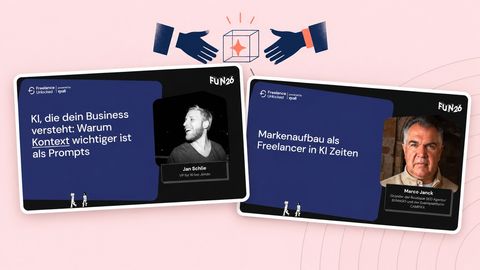
Marco Janck, who has run the SEO agency SUMAGO for 25 years, made the point at Freelance Unlocked in the least academic way possible. He had just spent half an hour arguing that everything online now looks machine-made, and then closed his talk without the usual slide deck link:
"Here I am on LinkedIn. As a human. No bot answers, it's always me. And sometimes I don't answer at all, but then that's human too, and you'll have to ping me again." (Marco Janck)
Earlier in the same talk he turned the argument into a positioning strategy: if everything is built by AI, the trick is to push back against it. His example was typos. If in future the way to be recognisably human is to make your own spelling mistakes, then fine, he said, he will make spelling mistakes. It sounds like a joke. It is the same mechanism the trust research describes, running in the other direction.
Marco also has the cleanest description of what clients are actually buying when they hire a specialist:
"At its core I sell security, nothing else. If you have an agent built for you, it's not about programming the agent, it's about the person who programs it giving you the certainty that it runs cleanly and doesn't drag you out of bed at night." (Marco Janck)
If you sell certainty, then the way you handle the AI question is not a side issue. It is the product demo.
Since 2 August 2026, part of this is no longer your call
There is a legal floor under the etiquette now, and a lot of freelancers still think it was postponed. It was not.
The European Commission's FAQ on Article 50 of the AI Act is the primary source, and Goodwin's alert confirms what the AI Omnibus did and did not touch: high-risk deadlines moved to December 2027 and August 2028, transparency obligations stayed exactly where they were.
Who it applies to. You are a "deployer" when you use an AI system professionally, meaning an activity through which you regularly gain an economic benefit. A freelance business qualifies.
What has to be labelled. Deepfakes, meaning AI-generated or manipulated image, audio or video content resembling real people, places or events. And AI-generated or manipulated text that is published to inform the public on matters of public interest: politics, public administration, justice, fundamental rights, public security, health, environment, consumer safety, and economic, scientific or cultural developments.
The exemption that covers most freelance work. Published text that has undergone human review or editorial control does not need to be labelled. The Commission ties this to a responsible editorial entity with authority to approve, alter or reject the substance of the text. Orrick's reading is the practical one: it has to be a deliberate substantive examination by a competent person, and "superficial, purely formal or procedural checks (spell checking, grammar correction, automated review processes) do not suffice".
Creative work. For deepfakes that are part of evidently artistic, creative, satirical or fictional work, disclosure is limited, and Orrick notes it must be done in a way that does not hamper display or enjoyment of the work. A caption, not a watermark across the poster.
Dates and fines. Article 50 has applied since 2 August 2026. Providers of systems already on the market get until 2 December 2026 for machine-readable marking. Breaches carry fines of up to €15 million or 3% of worldwide annual turnover. Those ceilings are aimed at large operators, but the duty is not.
Read together with the disclosure research, the law says something useful: real human review is both your legal exemption and your honest answer to the client. Doing the review is the point. Our piece on AI and copyright for creative freelancers covers the rights side of the same question.
The practical version: disclose the role, not the tool
Nobody is asking you to itemise your software. The useful distinction is between the tool and the role it played.
Jan Schlie, VP of AI at Jimdo and a solopreneur for four years before that, spent his Freelance Unlocked session on how to give AI enough context about your business that it stops producing generic output. Asked from the audience whether he lets it send anything on its own, his answer was immediate:
"What I let the AI do is write the draft. I look at it, improve it and then send it out, but I don't let it send blind." (Jan Schlie)
He backed it up with a story he clearly did not enjoy telling. He had asked his setup to pull his tasks together and generate an invoice, something his assistant had always got right. That one time he did not check it, just downloaded the file and attached it to an email. The client replied within minutes asking what on earth this was.
"I opened it, and there was the mistake. So, very good tip, always: the human matters more here." (Jan Schlie)
That is the disclosure framework in one habit. If a human genuinely reviewed the work and stands behind it, you can say so plainly, and Article 50's exemption applies for the same reason. If nobody did, you have a delivery problem long before you have a disclosure problem.
A workable three-tier rule:
- AI as a working aid (research, first drafts, variations, code completion) that you then reworked and checked: no proactive disclosure needed, and answer honestly if asked.
- AI in the delivered artefact (generated images, synthetic voice, AI-written passages that reach the client largely as generated): tell them before delivery, in the offer if possible.
- Anything Article 50 catches (deepfakes, public-interest text without genuine editorial review): label it, no judgement call involved.
The place to settle this is the contract, before the awkward moment arrives. A clause along these lines does the job:
The contractor may use generative AI systems as a working aid. All deliverables are reviewed, corrected and approved by the contractor before handover, and the contractor takes responsibility for their content. Content requiring labelling under Article 50 of Regulation (EU) 2024/1689 is labelled accordingly. Confidential client data is not entered into third-party AI systems without prior written consent.
That last sentence is the one clients care about most, and it is the one freelancers most often forget to offer.
What to do on Monday
- Write your AI clause once and paste it into every offer. Two or three sentences, above the price, not buried in the annex. It turns an awkward question into a professional signal.
- Ask your five biggest clients what they expect. A quarter of clients want proactive disclosure and almost none of them say so unprompted. One email settles it for a year.
- Check whether anything you produce is public-interest text. Press releases, health or finance content, anything published under a client's name to inform the public. If it goes out without real editorial review, it needs a label.
- Make the review real and short. Jan's rule works: AI writes the draft, you read it, you improve it, you send it. Never send blind, especially invoices.
- Put your review step in the offer as a benefit. Not "no AI used". Something like "every deliverable is reviewed and approved by me personally". That is the sentence that buys back the trust the research says disclosure costs.
Trust is what gets you the second project, and how you talk about AI is now part of it. Our piece on authenticity as a client acquisition strategy makes the broader case, and if you are still assembling your AI setup, the 9am Freelancer Toolbox is a decent place to start comparing tools.
If you want clients who already know how you work before the first call, create a free profile on 9am and put your terms where companies can see them.
Freelance Unlocked is co-organized by 9am together with Uplink and freelancermap. This article draws on the sessions of Jan Schlie and Marco Janck at Freelance Unlocked 2026. Watch the full talks above, and join us at the next edition: freelanceunlocked.com.