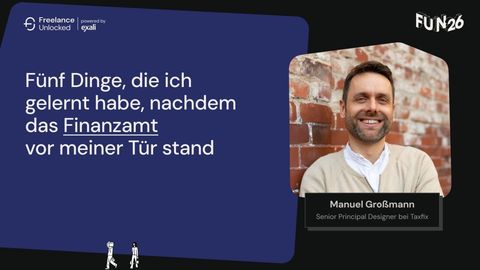

A letter from the Finanzamt, and in it one word that triggers instant panic: Umsatzsteuer-Sonderprüfung, a special VAT audit. A few weeks later, an auditor is sitting in your living room with a stack of paper. That's exactly what happened to Manuel Großmann, now Senior Principal Designer at Taxfix, before that roughly ten years a freelancer and agency founder. At Freelance Unlocked 2026 he told the whole story, along with the five habits that keep it from happening again.
Quotes translated from German.
Coffee, cookies and a stack of paper
His first reaction to the letter was raw fear. "What does this mean? Am I going to be convicted? Am I going to prison?" is how Manuel describes his thoughts at the time. Then he did what any grown adult in his mid-30s would do: he called his parents.
The audit itself turned out far less dramatic than the dread. Manuel worked from home, so he tidied the living room, dragged the dining table over from the next room and put out coffee and snacks. His genuine tip: build a human relationship with your auditor. She arrived with a pile of printouts and went through invoices one by one while Manuel pulled each of them up in his accounting tool. A hard drive from an Amazon seller in Italy, booked incorrectly. Six or eight faulty entries in total, all involving purchases from other EU countries. After about two hours, they were done.
Weeks later the official letter arrived: no deviation from the declared tax base. No back payment, no penalty, no prison.
"Our fear is almost always bigger than reality." (Manuel Großmann)
One detail he still laughs about: on her way out, the auditor tucked away her train ticket so she could claim it as travel expenses. The people at the Finanzamt have exactly the same problems we do.
What saved him (and what didn't)
Manuel took two things from that day. First: having a tax advisor is not a shield. He had one, and the mistakes happened anyway.
"You always think tax advisory, but sadly it isn't always advice. Our tax advisors managed us, they didn't really advise us." (Manuel Großmann)
Second: what actually saved him was his system. Because every transaction was filed digitally, he could answer every question in seconds. The auditor, for her part, was genuinely amazed by what software can do these days.
It hadn't always been that tidy. In his GmbH years, month-end meant printing bank statements, hunting down receipts, photographing them and mailing everything to the tax advisor. Horrible, in his own words. The switch back to freelancing became his reset: a friend gave him one simple tip he still follows today. Invoice in hand? Photo immediately, filed immediately.
Which leaves the real question: how do you actually change your behavior? Good intentions fail, as anyone who has tried to quit smoking knows. Manuel's answer is five principles from behavioral science, applied to taxes.
Lesson 1: Habit stacking
Manuel knows this one from James Clear's "Atomic Habits": take a habit you already have and attach the new one directly to it. If A, then B. Resolving to do ten push-ups a day fails. Doing them right after brushing your teeth sticks.
Translated to bookkeeping:
"Whenever I hold an invoice in my hand, no matter when, no matter where, I take a photo. And when I take a photo, I file it right away." (Manuel Großmann)
Because "I'll file it when I get home" never happens. The chain continues: if it's January and there's only a tax folder for last year, the new one gets created on the spot. Since Manuel started working this way, his records have been in order. In the GmbH era, they never were.
Lesson 2: The 2-minute rule
If something takes less than two minutes, do it now. For freelancers that means: track your time right at the context switch or before lunch, not "later". Write the invoice the moment a project ends; with a decent tool it takes five minutes. And above all, transfer the VAT immediately after filing the advance return instead of "tomorrow". Plenty of people file on time and then miss the payment, and late-payment surcharges are money burned for nothing. For reference: the advance return is due by the 10th day after the end of the reporting period.
Small things done immediately never get the chance to pile up. What piles up stays piled up.
Lesson 3: Clean slate
Behavior changes more easily at a clear cutoff. For Manuel it was the move from GmbH back to freelancing: new chapter, new rules. You don't get a break like that every day, but you can build one. The first of the month, the start of the year, a new client: pick a line and tell yourself, from here on I do this properly. Our brains love these fresh starts, and for tax matters the month or year boundary is the natural one anyway.
Lesson 4: Make it satisfying
The advance VAT return used to cost Manuel one hour a month, but it was the worst hour of the month. He'd reliably do it on the 9th of the following month at 11 pm, saved only by his deadline extension.
His fix: a reward system. Pair the unpleasant task with something you look forward to. As a designer he loves stationery, so: return submitted, €50 voucher for the favorite shop earned. Or a good book. Or the expensive matcha from Japan that only comes out after the VAT return is filed. It sounds silly, but it works because you're tricking your brain: the annoying task is reliably followed by a good thing.
Lesson 5: Become that person
The last principle is one Manuel named himself: don't ask who you are, ask who you want to be, and what that person would do. His non-tax example: he wanted to become a runner but still smoked occasionally. Instead of forcing himself to quit, he asked himself at every cigarette what a marathon runner would do. Probably not smoke it.
Applied to business: if you want to be a serial entrepreneur and the VAT return is waiting, ask how the person you're becoming would handle it. It's the little angel on your shoulder, and most of the time you already know the answer.
A special audit is not a rare event
In case you think it won't happen to you: German tax offices ran 63,733 special VAT audits in 2024 alone, collecting an extra €1.63 billion. You don't get to choose whether you're audited. Whether it ends in two relaxed hours over coffee and cookies or in a nightmare, you do.
The good news: you don't need to speak tax law, just run a system that puts every receipt where it belongs. For the mistakes worth never making in the first place, from the small business rule to missing tax reserves, see our overview of the 7 tax mistakes freelancers in Germany make.
And once the books are in order, the pipeline deserves the same care: 9am connects freelancers with vetted projects from companies across the DACH region. Create your free profile and let the next project find you.
Freelance Unlocked is co-organized by 9am together with Uplink and freelancermap. This article is based on Manuel Großmann's session at Freelance Unlocked 2026. Watch the full talk above, and join us at the next edition: freelanceunlocked.com.