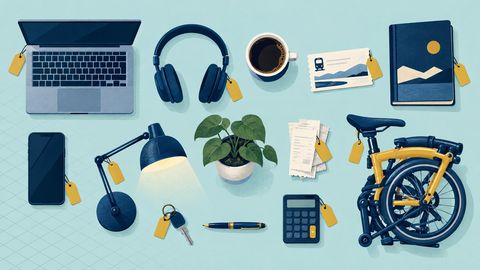

Most Betriebsausgaben checklists repeat laptop, training and travel. The money is usually in what they skip: the €6-a-day home office allowance you can claim without a separate room (up to €1,260 in 2026), the one-year write-off for computers and software, the €0.38 per kilometre that applies from the first kilometre since January 2026, and the 70% client dinner that becomes 0% without names on the receipt. Below are 13 items, each with the mistake that most often costs it. Every figure is the 2026 value with its paragraph.
The definition is one sentence in § 4 Abs. 4 EStG: Betriebsausgaben are expenses caused by the business. Almost every fight with the Finanzamt is about the exceptions in Abs. 5 and about paperwork, not about the principle. So this checklist does two things per item: the 2026 rule, and the error we see freelancers make with it.
1. Home office day allowance
Rule: €6 for every day you work mainly from home and do not visit an external workplace, capped at €1,260 a year (that is 210 days), under § 4 Abs. 5 Nr. 6c EStG. No separate room needed. Kitchen table counts. Mistake: claiming the day allowance and a dedicated office (item 2) for the same period. The law excludes that; pick one.
2. Dedicated office room
Rule: if the room is the centre of your entire professional activity, you deduct the actual costs (share of rent, utilities, insurance). Otherwise Nr. 6b gives you a flat €1,260 a year instead. Mistake: calling a room an office that doubles as guest room or hallway. Auditors ask for a floor plan and a photo. If the room is not used almost exclusively for work, you fall back to item 1.
3. Computers, monitors, software
Rule: the BMF-Schreiben of 22 February 2022 lets you assume a useful life of one year for computers, notebooks, peripherals and software. A €2,400 MacBook is fully deductible in the year of purchase. Mistake: spreading it over three years out of habit, because that is what the AfA table says. The one-year assumption is optional, but almost always the better option in a good year.
4. Small assets (GWG)
Rule: § 6 Abs. 2 EStG: anything up to €800 net of input VAT is an immediate expense. From €250 it goes on an inventory list. Alternatively, a pool (Sammelposten) for assets between €250 and €1,000, written off over five years. Mistake: Kleinunternehmer comparing the net price. If you cannot reclaim VAT, § 9b EStG makes the VAT part of the cost. A €790 net monitor is €940 gross, and no longer a GWG.
5. Desk, chair, camera, phone
Rule: above the GWG limit you depreciate over the useful life in the BMF AfA table: office furniture 13 years, mobile phones 5, cameras 7, PCs and printers 3 (unless you use the one-year rule from item 3). Mistake: expensing a €1,500 desk in one go. Correct is about €115 a year for 13 years, and the audit correction comes with interest.
6. Phone and internet
Rule: the business share of your contracts is deductible; there is no statutory percentage for the self-employed. Mistake: booking 100% of a family plan with no basis. Estimate a share you could defend, keep two or three months of itemised bills once, and note the reasoning.
7. Driving to clients and to your own office
Rule: two different rates. Business trips with your private car: €0.30 per kilometre driven (the Bundesreisekostengesetz rate referenced in § 9 Abs. 1 Satz 3 Nr. 4a EStG; Haufe confirms it is unchanged for 2026), or actual costs with a logbook. Trips between home and your own regular Betriebsstätte, such as a coworking desk: the Entfernungspauschale, which since 1 January 2026 is €0.38 per full kilometre of distance from the first kilometre, one way, per day; the BMF lists the change among its 2026 items. Mistake: applying the €0.38 distance rate to client visits, or the €0.30 driven rate to the daily commute. The first overstates, the second understates, and both look like you did not read the rule.
8. Meals on business trips
Rule: flat per diems under § 9 Abs. 4a EStG: €28 for a full 24-hour day away, €14 for more than eight hours and for arrival and departure days of a multi-day trip. Mistake: deducting the actual restaurant receipt for your own lunch. Your own meals are only deductible as the flat rate, never at cost.
9. Client dinners
Rule: § 4 Abs. 5 Nr. 2 EStG allows 70% of reasonable entertaining costs, and § 15 Abs. 1a UStG keeps the input VAT deductible in full. Condition: a record of place, date, participants, business occasion and amount, plus the itemised receipt. Mistake: a receipt with no names and no occasion. Then the deduction is not 70%, it is zero, and the VAT goes with it.
10. Gifts to clients
Rule: deductible up to €50 per recipient per year (§ 4 Abs. 5 Nr. 1 EStG). Mistake: the €55 bottle. Cross the limit by five euros and the entire €55 is non-deductible, not only the excess.
11. Training, books, conferences
Rule: fully deductible when the content relates to your current work, including the ticket, the train and the hotel. Mistake: booking the conference fee and forgetting the travel around it. The trip is part of the expense, and item 8 applies to the meals.
12. Insurance
Rule: professional liability, business legal protection and office contents insurance are Betriebsausgaben. Health, long-term care and pension contributions are not; they are Sonderausgaben under § 10 Abs. 1 Nr. 2 and 3 EStG. Mistake: putting health insurance in the EÜR. It still reduces your tax, just in a different box, and in the EÜR it distorts your profit, which matters for Vorauszahlungen and for bank conversations.
13. Bank account, bookkeeping, adviser
Rule: account fees, accounting software and your tax adviser are all deductible. Mistake: running the business through your private account. Every private expense that lands in the EÜR is a finding waiting to happen. A separate business account plus a tool that files receipts against transactions, for example Accountable (affiliate link), removes the most common audit finding before it exists. Alternatives are in the 9am Freelancer Toolbox.
What to do on Monday
- Count your home office days for 2026 so far and multiply by €6. If you have not been tracking, start a simple calendar note today; 210 days is the ceiling.
- Pull every 2026 purchase above €250 and decide: one-year write-off (hardware, software), GWG (up to €800 net), or AfA table.
- Open your last three client dinner receipts. If names and occasion are missing, add them now while you still remember, dated honestly.
- Split your driving into client trips and commutes to your own desk, and apply €0.30 and €0.38 respectively.
- Move health and pension contributions out of the EÜR and into Sonderausgaben, if they are in the wrong place.
The list above only lowers your tax if the profit exists in the first place. If your pipeline is thinner than your receipt folder, a free 9am profile is the shortest route to companies across DACH that hire freelancers.
How much of that profit to put aside for the tax office, and how to lower your prepayments when a year goes badly, is in How much tax to set aside in 2026. The broader errors are in our piece on freelancer tax mistakes in Germany, and what an actual audit looks like is in Tax audit as a freelancer.
This article is general information for practitioners and does not replace tax or legal advice.