

The "five-sixths rule" that advice pages still quote as the test for false self-employment left the law on 1 January 2003. Today § 7 SGB IV asks about instructions and integration and says nothing about revenue shares. The five sixths survive elsewhere: § 2 Satz 1 Nr. 9 SGB VI makes you liable for statutory pension insurance if you have no insured employees and work essentially for one client, and the DRV's own form asks whether one client brings at least five sixths of your business income. A contribution question, not a status question, and it costs real money.
Ask ten freelancers how much revenue from one client is too much and eight will say something about 80 percent, five sixths, or "you need at least three clients". Ask where that comes from and the answers stop. Here is the honest version, in the order the rules actually apply to you.
The rule everyone quotes was repealed in 2003
Between 1999 and 2002, § 7 Abs. 4 SGB IV carried a catalogue of five criteria. Meet three of them and the law presumed you were an employee. One of the five, in the wording quoted by Hensche, was: "sie ist auf Dauer und im wesentlichen nur für einen Auftraggeber tätig."
That presumption was abolished with effect from 1 January 2003. The research service of the Bundestag records the repeal, by the Zweites Gesetz für moderne Dienstleistungen am Arbeitsmarkt of 23 December 2002, and the reason: it "hat in der Praxis aufgrund des zu beachtenden Amtsermittlungsgrundsatzes keine weitere Bedeutung erlangt". Note what the old criterion did not say. It set no percentage. The five-sixths figure was never in § 7 SGB IV.
What is in § 7 SGB IV today is one sentence: "Anhaltspunkte für eine Beschäftigung sind eine Tätigkeit nach Weisungen und eine Eingliederung in die Arbeitsorganisation des Weisungsgebers." No revenue share, no client count. One client does not make you an employee, and five do not protect you if you sit in the client's team under a team lead.
Where the five sixths actually live
They live in pension law, and there they are precise.
§ 2 Satz 1 Nr. 9 SGB VI makes self-employed people liable for statutory pension insurance when both of the following apply: they "regelmäßig keinen versicherungspflichtigen Arbeitnehmer beschäftigen" and they are "auf Dauer und im Wesentlichen nur für einen Auftraggeber tätig". For partners in a partnership, the clients of the partnership count as theirs.
"Im Wesentlichen" is where the number comes back. The DRV's own application form for people in exactly this position, V0050, asks it directly: "Beziehen Sie auf Dauer mindestens fünf Sechstel Ihrer gesamten Betriebseinnahmen aus diesen Tätigkeiten von einem dieser Auftraggeber?" Five sixths is 83.3% of your business income.
This is not a status finding. You stay self-employed, you keep writing invoices, nothing about your contract changes. You simply become a compulsory member of the statutory pension scheme. In 2026 the rate is 18.6% and the Bezugsgröße is €3,955 a month, so the standard contribution works out at €735.63 a month on our own arithmetic, with an income-based amount available on proof of your actual earnings.
Two exits are written into § 6 SGB VI. Abs. 1a exempts you for three years after you first take up self-employment, and again if you start such an activity after your 58th birthday. Timing matters: under Abs. 4 an application within three months works from the day the conditions were met, a later one only from the day it lands. Renaming your business does not restart the three years.
And where it may come back
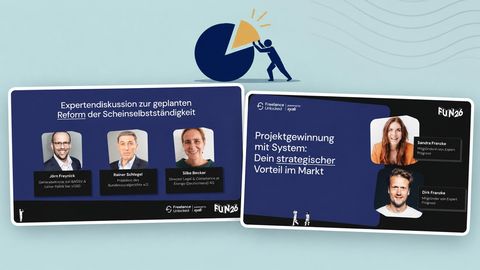
The leaked BMAS draft for a voluntary "neue Selbstständigkeit" status puts the same idea back into the status test. As LTO reported on 26 April 2026, the draft would require a right to send a substitute plus at least two of four criteria, one of them being that you do not work "im Wesentlichen nur für diesen Auftraggeber". Professor Rainer Schlegel, former President of the Federal Social Court, read the list out on stage at Freelance Unlocked 2026:
"He is not working essentially only for this one client." (Rainer Schlegel, translated from German)
Same phrase, same ambiguity, target date 1 January 2028. As of the writing date the text is still a Referentenentwurf with no cabinet decision. What it would cost and where it stands is in our piece on the leaked status reform draft. The relevant part here: a client mix that is comfortable today would still be comfortable under the draft.
Three lenses on the same number
The DRV lens. Two separate questions, often confused. Status (§ 7 SGB IV) is about instructions and integration, and one client is not a criterion, though it is what tends to open a file. Contribution duty (§ 2 Satz 1 Nr. 9 SGB VI) is about five sixths and no employees, and it is a yes-or-no with a euro amount attached.
The lender lens. Banks and leasing companies price the risk that your income stops. One client at 90% of revenue on a four-week notice period reads worse than four clients at 25% each. We could not find published data on how German lenders actually weight client concentration for self-employed applicants, so treat this as the mechanism, not as a rule with a threshold.
Your own lens. Concentration is not dangerous because of a percentage, it is dangerous in combination: a high share, a short notice period, no reserve. Any two of those are survivable. All three is how a good year turns into a bad one in six weeks.
What the data does not say
There is no current published figure for how many clients a German freelancer has, or what share the largest one takes. We checked the Freelancer-Kompass 2026 and the freelance.de Freelancer-Studie 2026 (more than 3,300 participants, published 13 March 2026) and neither reports it. The nearest number is freelance.de's finding that 52% of respondents completed only one or two projects in the last twelve months. That counts projects, not clients, and two projects can be one client or two. It is not a concentration statistic and should not be used as one.
So the benchmark has to be your own.
Your concentration score
Open your paid invoices for the last twelve months and write down four numbers.
- Share. The largest client's revenue divided by total revenue. Above 83% you are in five-sixths territory. Between 50% and 83% is normal and fragile. Below 50% is fine.
- Clients. How many clients paid you anything at all. One is a job with extra paperwork. Two is a coin flip. Three or more is a business.
- Notice. The notice period in your largest contract, in weeks, multiplied by your monthly fixed costs. That is the cash the contract itself guarantees you.
- Reserve. Months of fixed costs in the bank. Under three, concentration is not a strategic question, it is an urgent one.
If number one is above 83% and number four is under three, that pair is your project for this quarter.
The 90-day plan
Dirk Franzke spent more than ten years on the intermediary side of the market, still holds shares in a project brokerage and co-founded Expert Brokers, so read his advice as a practitioner's system, not as research. His argument for direct clients is not about rates:
"It is often about having two or three clients in parallel and not being fully booked any more, but that removes the concentration risk. If one client drops out, the other two are still there." (Dirk Franzke, translated from German)
His diagnosis of why most freelancers stay concentrated is sharper than any statistic. You get into a project, you disappear into it, and two weeks before it ends you send one panicked email to everyone you know. His fix is a habit, not a campaign:
"Decouple sales from your project status. Do sales or account management even while you are currently in a project." (Dirk Franzke, translated from German)
Ninety days, four moves:
- Days 1 to 10. Write the four numbers down and set one target: largest client under 60% of revenue by the end of the quarter, or one additional paying client.
- Days 10 to 30. Franzke's low-hanging fruit: your own network into a simple CRM, former colleagues and past clients on a list, two conversations a week. The mechanics are in our guide to building a constant client pipeline.
- Days 30 to 60. Add one channel you do not use today. Platforms are where most DACH freelancers now find work, covered in platforms as the number one client channel. Two or three intermediaries who know your name beat twenty who have your CV.
- Days 60 to 90. Renegotiate the notice period in the big contract, not the rate. Four weeks to three months is worth more than five percent.
What to do on Monday
- Calculate your share. Last twelve months, largest client, one number. Write it on a sticky note.
- Check the pension question. No insured employees and above five sixths from one client means § 2 Satz 1 Nr. 9 SGB VI applies to you. If you started less than three years ago, the § 6 Abs. 1a exemption exists, and the three-month deadline is why you look at this today.
- Run the status check separately. 9am's free false self-employment self-check asks about instructions and integration, which is what § 7 SGB IV actually tests. Twenty minutes.
- Book two pipeline conversations this week, while you are still busy. That is the whole of Franzke's point.
- Read your notice clause. If it is four weeks, you have four weeks of guaranteed income, whatever the relationship feels like.
If the sticky note says 90%, the answer is not a clause and not a lawyer. It is client number two. A free 9am profile puts you in front of companies across DACH that hire freelancers, and a second client fixes the audit question, the lender question and the sleep question at once.
This article is a practitioner's explainer and general information. It does not replace legal or tax advice on your situation.
Freelance Unlocked is co-organized by 9am together with Uplink and freelancermap. This article draws on the expert panel on the false self-employment reform and the session of Dirk Franzke and Sandra Franzke at Freelance Unlocked 2026. Watch the full talks above, and join us at the next edition: freelanceunlocked.com.