For the first time in over 20 years, Germany has a real reform of its false self-employment rules on the table. The bad news: the first draft from the Federal Ministry of Labour was so far off the mark that the Chancellery stopped it before it could even be circulated officially. Everything that matters for freelancers in Germany right now is playing out between those two sentences.
We've tracked this topic at Freelance Unlocked for three years, and if you line up the sessions from 2024 to 2026, you can see exactly how the debate has shifted. From "the pension insurance hunts freelancers and politics looks away" to "the law is coming this year, let's fight over the details". Here's the story, year by year, and at the end the question that counts: what should you do with it?
2024: Learning the rules of a broken system
At Freelance Unlocked 2024, Benno Grunewald, a specialist tax lawyer with more than 20 years of DRV cases behind him, boiled the core problem down to a simple formula. Legally, there are only three statuses: employed, self-employed with no obligations, or self-employed but subject to mandatory pension insurance. "Scheinselbstständigkeit", false self-employment, isn't a status at all. It's just the label for the moment when nobody has decided yet which box you belong in.
His advice back then was mostly about defense. Keep social insurance liability and pension insurance liability strictly apart, because the first puts the back-payment risk on your client and the second puts it on you. Watch the five-sixths threshold: earning more than about 83 percent of your revenue from one contract partner triggers the pension trap. Build your paperwork on general terms plus individual orders rather than a framework agreement, which the DRV likes to read as proof of a permanent relationship. And on requesting a status determination mid-project, his verdict was blunt: keep your hands off it. The full breakdown is in our article on pension insurance and contracts.
What stands out in hindsight: in 2024, nobody seriously discussed changing the law itself. The game was surviving inside a system everyone treated as fixed.
2025: The legal status quo that still applies today
A year later, Dr. Hartmut Paul, a social insurance law expert who had once audited companies for the pension insurance himself, explained why the system feels so unpredictable. Dr. Paul has since passed away. His session remains one of the clearest ever given at Freelance Unlocked, and his analysis still holds.
The core of it: the statute says almost nothing. § 7 SGB IV names just two indicators of employment, working under instructions and integration into the client's organization. Everything else comes from decades of court rulings, and every case is decided by an overall assessment of all circumstances. That's why the same contract clause can be harmless in one setup and decisive in the next. The status determination procedure at the DRV clearing office was meant to create certainty and was reformed in 2022, with temporary instruments such as the advance decision running until 30 June 2027. Paul publicly criticized the fact that since the reform, the clearing office only rules on the status itself, not on the concrete insurance consequences. For the full picture of the law as it stands, read our guide to false self-employment.
And then there was Herrenberg. In 2022, the Federal Social Court classified a music school teacher as an employee, and the shockwaves reached far beyond education. The legislator responded with a transitional rule under § 127 SGB IV, since extended to the end of 2027. Herrenberg became the catalyst: at that point even politicians agreed that the line between self-employed and employed had to be redrawn by law.
2026: Politics promises delivery this year
The federal election put the topic into the coalition agreement: CDU/CSU and SPD promise an "effective reform of the status determination procedure" for more legal certainty, tied to a mandatory retirement provision for the self-employed. At Freelance Unlocked 2026, that thread ran through three sessions.
In the politics panel on day one, Wilfried Oellers (CDU/CSU), his parliamentary group's rapporteur on the issue, committed himself: procedurally, passing a law in 2026 is possible, and the criteria finally have to get concrete, because instructions and integration alone are "simply too thin". Author and podcaster Cathi Bruns captured the community's impatience in one line: liberalizing independent work is "an economic stimulus program that costs nothing".
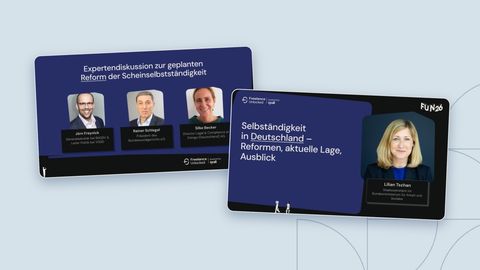
On day two, Lilian Tschan took the stage, State Secretary at the Federal Ministry of Labour and Social Affairs. Her showing up at a freelance conference was a signal in itself. Her numbers came from a BMAS research report based on a representative survey of more than 2,000 self-employed people: 3.5 million people in Germany are self-employed as their main occupation, more than half of them solo. Many stand on solid ground economically, but for roughly one in five, the situation is considerably harder.
She couldn't say much about the draft law itself, but she did lay out her guardrails. The declared will of both contract parties should carry more weight in the future. Self-employment means entrepreneurial activity and must remain visibly distinct from employment. No special rules for individual industries. And the goal: new legislation by the end of this year. When I asked her on stage whether the reform should also make self-employment easier, she answered without hesitation: "Yes, without qualification."
"Our goal is to make this distinction so clear and so simple in the future that this simply no longer happens." (Lilian Tschan on retroactive reclassifications and back payments, translated from German)
That retroactivity is the heart of today's problem: an audit years later can reclassify an engagement after the fact, with back payments that usually hit the client and cost the freelancer the contract.
The leaked draft: "new self-employment" in detail
Right after Tschan's talk, an expert panel dissected what the ministry actually has in mind. On stage: Jörn Freynick, Secretary General of the umbrella association BAGSV and Head of Policy at VGSD, Silke Becker, Director Legal & Compliance at Etengo, and Prof. Dr. Rainer Schlegel, former President of the Federal Social Court. All three knew the draft bill that was never meant to go public and leaked to the press in early summer, mid-way through the government's internal coordination.
Schlegel summarized the contents. The draft creates a new legal construct called "neue Selbständigkeit", new self-employment: an engagement counts as self-employed if four conditions come together. Both parties agree at contract signing that this is self-employment. The work shows typical features of entrepreneurial activity. The contractor wasn't employed by that same client immediately beforehand. And the client reports the start of the engagement within six weeks.
Entrepreneurial activity gets its own definition: the contractor must have the right to send a substitute, plus meet at least two of four criteria: risk of loss and chance of profit, not working essentially for one client only, business-typical expenses, and marketing yourself on the open market. Whoever qualifies becomes subject to statutory pension insurance: 18.6 percent on 90 percent of the agreed fee up to the contribution ceiling, withheld and paid over by the client, exactly like payroll.
The catch, which Schlegel spelled out precisely: all of this applies to social insurance law only. Employment law and tax law remain explicitly untouched. A works council can still have you examined as a possible employee, and the tax office can still demand wage tax while the pension fund treats you as self-employed.
Why the experts take the draft apart
Silke Becker, who deals with these setups daily as an in-house lawyer, raised three objections. First, the new legal construct that exists only in social insurance law: "For a practitioner like me, that's a catastrophe." Second, the substitution clause, which must be in the contract even though the ministry reportedly said it "doesn't have to be lived". How is she supposed to advise clients to write down something nobody means? Third, having the client withhold and remit contributions, which effectively turns an invoice into a payslip. Her verdict:
"In many places it just isn't thought through. It makes everything so complicated." (Silke Becker, translated from German)
Jörn Freynick went after the substitution requirement. His punchline: if you book a specific speaker for Freelance Unlocked, you don't want someone else showing up. "It also implies that every self-employed person is simply interchangeable." The reality of trainers, consultants and specialists is the opposite: they get booked precisely for their individual experience. His second objection: in every previous compromise, the retirement provision duty was meant for new entrants into self-employment. The draft extends it to everyone, including the roughly 95 percent who already provide for old age, often through long-running private contracts or property. His association sent the ministry more than 40 questions within days of the leak.
Schlegel, for his part, considers a provision duty inevitable. It has appeared in coalition agreements for three legislative periods, and proportionally twice as many self-employed people as employees end up on basic income support in old age. His quarrel is with the how: the state may demand an outcome, a secured retirement income above the basic support level, somewhere around 1,000 to 1,300 euros. But the form of provision, statutory, private, shares or property, must remain a free choice. That was the panel's common ground: positive criteria yes, assessing the person as a whole instead of every single engagement, and a provision duty with freedom of choice rather than a forced route into the statutory pension.
Where the reform stands now
The state of play, as of late August 2026: the leaked draft is on hold, the Chancellery stopped its circulation to the other ministries. CDU/CSU and SPD are negotiating, with Wilfried Oellers among the negotiators for the Union. The declared goal remains a law this year, not least because the Herrenberg transitional rule expires at the end of 2027 and the EU Platform Work Directive has to be transposed into national law by year-end. In parallel, the government's pension commission is delivering its final report, which also covers the question of which groups should be brought into the statutory pension system.
Almost everything important is still open: which positive criteria make it into the law, whether the substitution clause survives, whether the provision duty applies only to new freelancers or to everyone, and whether the outcome is a genuine system change or just another layer of complexity. Even so, the mood on the panel was cautiously optimistic. For the first time, all sides are talking about positive criteria, and for the first time there's a government promise with a date on it.
What you should do now
Until a new law takes effect, the old law applies, audits included. That translates into a concrete list:
- Run your business so it visibly looks like one. Several clients over time, your own equipment, your own rates, your own marketing, real profit and loss risk. That protects you today in the overall assessment, and these are exactly the features every reform variant treats as positive criteria. Our guide on avoiding false self-employment covers what counts, and 9am's free false self-employment self-check gives you a first reading on your own setup in a few minutes.
- Watch the five-sixths threshold. The pension insurance obligation under current law hits you, not your client. A second genuine contract partner defuses it.
- Keep your contract hygiene up. Paper and practice have to match: no integration into team structures, no instructions as if you were staff. Grunewald's terms-plus-order approach hasn't aged a day.
- Start or document your retirement provision. Some form of provision duty is coming; on that, everyone on stage agreed. If you can prove you've been providing for years, you'll be better placed under any conceivable transitional rule.
- Get involved. The associations are negotiating the criteria that will define your business model five years from now. VGSD is collecting data from self-employed people through a survey, and Schlegel's advice to every individual was meant seriously: talk to your local MP and stay persistent. "Pestering works."
The strongest protection is structural, though: if you don't depend on a single client, you score better on almost every criterion there is. Build yourself a broader project pipeline in the DACH market with a free profile on 9am.
This article is for information only and is not legal advice.
Freelance Unlocked is co-organized by 9am together with Uplink and freelancermap. This article is based on the expert panel on the false self-employment reform and Lilian Tschan's session at Freelance Unlocked 2026, plus earlier sessions by Benno Grunewald (2024) and Dr. Hartmut Paul (2025). Watch the full talks above, and join us at the next edition: freelanceunlocked.com.