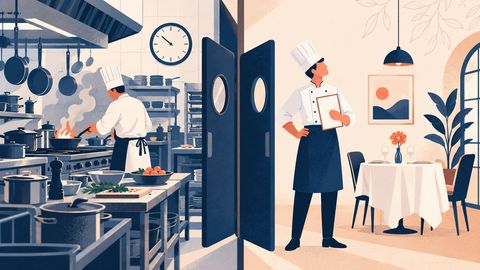
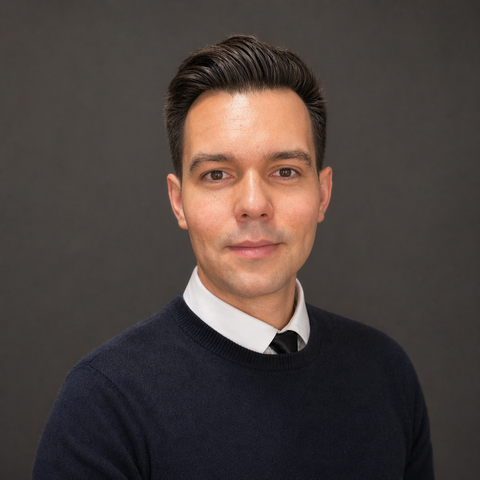
A cook executes dishes in other people's kitchens and trades time for money. A chef owns the restaurant: menu, clients, systems. Ricardo Brito's point at Freelance Unlocked was not that one is better, but that most freelancers are cooks who believe they are chefs, and that mismatch keeps them hunting for the next kitchen after ten years. Six questions below tell you which one you are today. If you are a cook, be the best one. If you want the restaurant, Bao Hanh Nguyen's eighteen months show the price: one topic, much declined work, content that sounds like you.
"Solopreneur" is either the future of freelancing or a rebrand for people who sell courses. Ricardo Brito, a Portuguese designer turned solo-business coach who runs the Solo Accelerator, a programme for exactly this transition, gave the most useful definition of the year at Freelance Unlocked. It fits on a menu card.
Cook or chef
Walk into any kitchen and everyone looks busy in the same way. Stay long enough and you see two jobs. The cook executes a dish: very good at chopping and plating, years to master the craft, paid by the shift. The chef decides which dish gets cooked, why it is on the menu, how it makes money and what experience it creates. Both are real professions. You can live a whole life as either.
"If you are a cook operating as a chef, you have a problem. If you are a chef operating as a cook, you have another." (Ricardo Brito)
The freelancer, in Ricardo's telling, is the cook: kitchen to kitchen, collecting knives and proud of every one. The solopreneur is the chef who builds a restaurant.
"You move from kitchen to kitchen. You are kind of a mercenary. You go from place to place and you have a great time, but you are not compounding. After ten years, you worked in twenty different kitchens, but you still need to look for the next kitchen." (Ricardo Brito)
Four years ago, he says, he was a cook pretending to be a chef: too many clients, too few processes, dishes people sometimes liked and sometimes did not, budgets all over the place. The fix was not a new product. It was deciding what restaurant he was running and for whom.
The six questions
Answer each one honestly, in writing. Count how many times you land on the right-hand side.
1. Whose kitchen are you in? Cook: I work inside my clients' teams, tools and priorities; when a project ends I start the search again. Chef: clients come into my process, my way of working, my terms.
2. Who is your restaurant for? Cook: whoever has a budget for my skills this quarter. Chef: a specific type of client with a specific problem, named in one sentence. Ricardo's own answer names two groups: experienced freelancers who never had to do sales or marketing and now struggle to find work, and people leaving corporate to build a solo business on purpose. Without that sentence you do not know your restaurant, and without the restaurant you cannot design the menu or the price.
3. What is on the menu? Cook: everything a client ever asked for. Graphic design, then branding, then a workshop, then a landing page, added one dish at a time out of fear of losing business, until it reads like a twenty-page menu nobody orders from. Chef: an appetizer, a main, a signature dish people know you for, and a clear list of what you do not serve.
4. Do you talk about knives or dishes?
"We keep talking about knives. We keep talking about the oven. We don't talk about the dishes, the outcomes we create for our clients." (Ricardo Brito)
Cook: my profile lists tools, skills, certifications and process. Chef: my profile says what changes for the client, and the tools come up when they ask. Employment trained us to prove capabilities. Clients want a sanity check that you can deliver the outcome; the how comes later.
5. Does the kitchen run when you are not there? Cook: if I stop, everything stops. Chef: there are processes, steps, costs and a logic behind which dishes exist. A real kitchen keeps running when the chef steps out. Ricardo built onboarding, a CRM and automations he never mentions to clients. Back-end, but there.
6. Are you compounding? Cook: each project ends and leaves a reference, an invoice and not much else. Chef: each year leaves assets that make next year easier, a body of work, an audience, a repeatable offer, a network that sends people.
Six cook answers: you are a cook, a real profession. Ricardo's only demand is intention: be the best cook you can be, and stop pretending to be a chef. Six chef answers: you are building a restaurant, and the question is which one. Anything in between is the uncomfortable middle he warns about. The pattern to watch for is cook on 1, 3 and 4 and chef on 2 and 6: a specialist with real expertise and a growing reputation who still sells knives by the shift.
What the numbers say about the middle
The middle is crowded, and getting more so. Upwork's Future Workforce Index 2026, a survey of 2,400 US workers in March and April 2026 published by a marketplace with an interest in the answer, reports skilled freelancing rising from 28% of skilled knowledge workers in 2025 to 38% in 2026, and 58% of full-time employees considering it, up from 36%. It also finds freelancers ahead of employees on AI agents, 41% against 34%. Vendor data, US only, but the German founding numbers point the same way: the KfW-Gründungsmonitor 2026 counts around 690,000 founders in 2025, 86% of them solo, and 57% report difficulty winning clients. More cooks, all looking for kitchens. Being a very good cook is a harder position to hold than it was.
What building the restaurant actually costs
Bao Hanh Nguyen, an AI and design-thinking coach at the Hasso Plattner Institute, is in her third year of freelancing and described her switch from cook to chef from the inside. In January 2025 a signed long-term contract as an IT product manager was cancelled at short notice. She was ill, lonely and about to apply for jobs again.
Instead she picked one restaurant: bringing women to the front of the AI shift, through learning programmes. Eighteen months later, by her own count from the stage, she had gained over 7,000 LinkedIn followers and 3,000 newsletter subscribers, reached more than 2,000 women and shipped eight learning products. Her numbers, not audited ones. The decisions behind them are the transferable part.
She started by looking at her old profile:
"Why would anyone book a person who does three things, when they could book a person who does exactly one thing really well?" (Bao Hanh Nguyen)
Design thinking coaching, IT product management, workshop facilitation. Nobody booked it. One sentence replaced the three, and it worked.
The hardest part was not the sentence. It was the phrase she kept repeating: "You have to decline." Turning down work that paid quickly but built nothing.
"When you work as a freelancer, you build things for clients, and once they have them and are happy, they might not need you any more. And what have you built for yourself in the meantime?" (Bao Hanh Nguyen)
That is Ricardo's question 6 from the other side of the invoice. Her habits are chef habits: she sold the first programme before it existed, had over 300 sign-ups three days before the start, then built each week from participants' feedback; she plans content five weeks ahead; she rebuilds her AI materials every three months because the tools move; and she keeps the personal stories in, because in a feed full of generated text the human tone is the one thing that does not get copied. Her line for the mindset shift: her business is limited by her, so most of the work turned out to be work on herself.
Which restaurant
If you land on the chef side and want the map, we have covered the routes: digital products for a company of one, the five paths from freelancer to company, and what is really behind a scalable solo business at €100k a month. Ricardo's answer to "when should the shift happen" is as early as possible: your expertise as a freelancer is the product of the solo business anyway, and building the processes early makes you a better freelancer too.
One warning from his Q&A for anyone in a downturn: your ideal client may not be the one paying right now. If your offer is a nice-to-have, move it to a must-have problem or find the angle your clients cannot postpone.
What to do on Monday
- Take the test in writing. Six questions, one line each, cook or chef. Date it for next year's comparison.
- Write your restaurant sentence. "I work with [type of client] who [specific problem]." If it takes more than one sentence, you have two restaurants or none.
- Rewrite one profile paragraph from knives to dishes. In your 9am profile or LinkedIn summary, strike every tool and skill from the first three lines and replace them with what changes for the client.
- Name your signature dish. The one thing you want to be known for by December. Everything on the menu that does not feed it goes to the bottom or off.
- Decline one thing this month. Bao's rule. Take the next request that pays but builds nothing and say no, on purpose, to learn what it feels like.
Cook or chef, the restaurant needs guests. A free 9am profile written in dishes rather than knives is how companies across DACH find the one thing you do really well, and a full calendar is the best position from which to decide what you build next.
Quotes by Bao Hanh Nguyen translated from German.
Freelance Unlocked is co-organized by 9am together with Uplink and freelancermap. This article draws on the sessions of Ricardo Brito and Bao Hanh Nguyen at Freelance Unlocked 2026. Watch the full talks above, and join us at the next edition: freelanceunlocked.com.