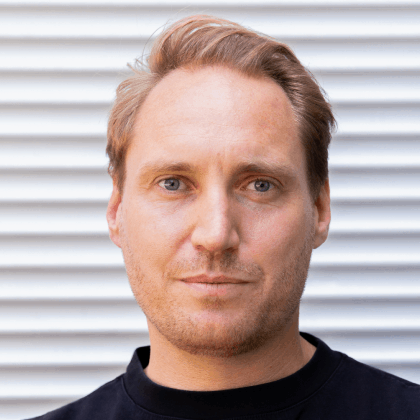
Daniel Neuhaus has been booked for almost ten years and still applies for new projects every three to six months, whenever his contract comes up for extension, to test his market value. His system at Freelance Unlocked 2025: define a top client by budget and extension, rebuild your profile around results in the first ten seconds, use recruiters for reach and referrals for trust, and keep a written emergency protocol for the day a client cuts you. 62% of DACH freelancers name client acquisition as their biggest hurdle. He treats it as a daily habit, not an emergency.
"You don't have a product. You are the product." That is the sentence Daniel Neuhaus built his Freelance Unlocked 2025 session around, and it explains why a freelancer who has been fully booked for close to a decade spends part of every week selling.
Daniel works in regulatory and compliance projects at the interface between IT and business, has been fully remote for four years, and describes his first five years of freelancing as lonely. The talk, given in German in May 2025, is a system rather than a story: what a top client is, how to be invited, and what to do when it ends.
What a top client actually is
His definition is unsentimental. A top client has budget: a short engagement at a high rate or a longer one at a medium rate, but always the means to keep you. A top client pays a premium for a slightly better skill set that is positioned well, expects communication, often a small project-management role on top of the craft, and extends.
That last one is why he keeps selling inside the account. "I have been with the same client for several years. I advertise myself in-house and outside." Fully remote, never once in the client's office, "but everyone knows me, because every week I have a coffee call with one person or another."
And the habit most freelancers would never dare:
"Every three to six months, whenever my contract extension comes up, I apply all over again, because I keep testing my market value. What are other clients paying for me now? Now I have more skills, more experience. What does it look like?" (Daniel Neuhaus, translated)
The first ten seconds
The day before his talk he spoke to about 40 people at the conference. "They all said: I'm a developer. Fine, a developer, but what do you develop? What did you do before? Which clients did you have?" His rule is that the first three to ten seconds of any introduction decide, so the intro carries results: numbers, dates, facts, within a fixed timeframe. Not "I am a developer" but "I have built a hundred apps".
The same logic rebuilds the CV and the consultant profile. Result-oriented, KPI-first, and NDA-safe: "If you closed five million in three months and you cannot say five million, say seven figures." The client's reaction he is aiming for: "Wait, he did that for the other client, he can do it for me too."
One smaller move from the same section: he rates his own skills with deliberate understatement, four stars out of five for Excel, so that in the interview the client asks about it and he gets to tell a concrete story instead of defending a claim. "Talk about your strengths yourself, before they ask you about something you may not know."
Every step is a pitch
His picture of the funnel has three levels of reach.
One-to-one applications on platforms are cold leads: one application moves one person. Worth doing, two or three a day, but never the whole plan. Once you reach the interview you compete with two others, "and then it is usually not skill. Sometimes a bit of price. Very often it is personality."
Recruiters are one-plus-x. "They have the network. You should never leave that out." His framing for what they add: "To convince, you need a witness, someone who speaks for you."
Direct contacts and referrals are the lever squared, and they are inbound. "It doesn't matter what you can do. What decides, mostly, is who you know and who recommends you." Most of his projects came through recruiters or referrals, and the network of his network is the target. His instruction to the room: if you have not talked to 50 to 100 people here, go and do it after the talk.
The DACH numbers back the priority. In the Freelancer-Kompass 2026, 5,412 freelancers surveyed between November 2025 and February 2026, 62% name client acquisition as their biggest hurdle, and 55% say the greatest value of their network is new projects. Daniel's answer: invest in the network while you do not need it, "because when you need it, it is there." A weekly coffee call, a lunch, adding people in your niche on LinkedIn, and a CRM in which he notes who he spoke to, when, and what they care about outside work. "You were on holiday there? I've been there too. Now you have a bond." He admits the research can backfire: he once congratulated a client on being a Cologne fan, who turned out to support Leverkusen. The client laughed. Our pipeline guide turns the habit into a weekly routine, and our piece on authenticity as an acquisition strategy explains why the personality part is not a trick.
When the client asks a question, he answers in case examples. Not "yes, I can do that" but "I solved that at a client like this, and here is how."
LinkedIn is a landing page
Personal branding, in Daniel's version, is a daily investment made while fully booked. Post, and comment on the posts of people in your niche. Publish in English if you want the whole world, in German if you want DACH. And treat the profile as a page with a job: "LinkedIn is a landing page, more than a profile. The message has to be clear: what you do and what you stand for." His has reviews from clients and colleagues and a call to action that lets anyone book a 15-minute coffee call straight into his calendar. Behind that sits a "success delivery" PDF per project. "It doesn't matter what you say about yourself. What decides is what everyone else says." How to build the profile that carries that is in our freelancer profile guide.
His overall strategy: breadth first, brand and recruiter network, so that you have reach; then depth on the few applications that fit exactly, with a cover letter and the PDF, "so people see he is putting in extra effort, he is not like everyone else."
The emergency protocol
The part of the talk that drew the most nods was not about winning. It was about losing a client overnight. "The client takes you off the project. You don't know why. You think it's your fault. You may never find out." So he wrote a step-by-step protocol for himself, because in that moment you are emotional.
"First it says: calm down, relax, take a breath, it is not your fault. Budget cut, maybe they brought in a big consultancy, whatever. Next step: network. Then comes my A team, the people I am very close to. Then my B team. Then my recruiters. I work through all of them." (Daniel Neuhaus, translated)
That document later became a product with a partner, a free guide of 101 positioning strategies, which he mentions on stage; the useful part for a reader is the protocol itself, written before you need it. If the first step of yours involves writing to strangers, our guide to cold outreach within the UWG has the legal channels and the templates. And when three recruiters send you the same project: "I tell them the same answer a hundred times: that is my price."
What to do on Monday
- Rewrite the first two lines of your profile as a result. Numbers, clients, timeframe. NDA-safe wording where needed.
- Book your market test. Put a reminder three months before your current contract ends: apply to two projects, even if you plan to extend.
- Send your profile newsletter. One email to your network with what is new since the last one: a skill, a role, a certificate.
- Write the emergency protocol. Step one: it is not your fault. Then your A list, B list and recruiters, with names.
- Add the calendar link. A 15-minute coffee call anyone can book from your profile, and one coffee call a week inside your current client.
Reach was Daniel's first move, and a free 9am profile adds one more channel where DACH companies search for freelancers by the results you wrote in line one.
Quotes translated from German and lightly cleaned from automatic captions.
Freelance Unlocked is co-organized by 9am together with Uplink and freelancermap. This article is based on Daniel Neuhaus's session at Freelance Unlocked 2025. Watch the full talk above, and join us at the next edition: freelanceunlocked.com.